Ayurvedic Management of Buerger’s Disease
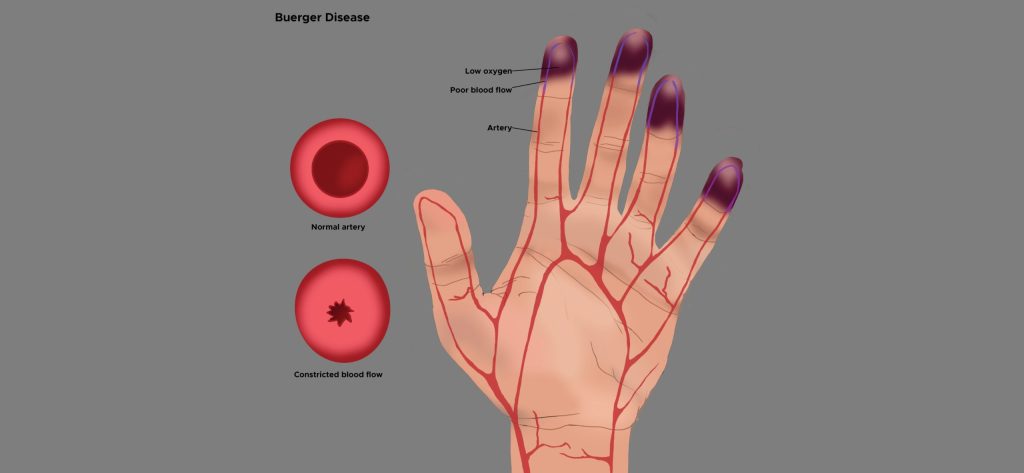
Buerger’s disease, also known as Thromboangiitis obliterans or Winiwarter-Buerger disease, is the inflammation of small and medium-sized blood vessels. It is a type of vasculitis that causes thickening, or a blockage, of the blood vessels in the feet and hands. When the blood flow is blocked through the hands and feet, an individual may have pain and tissue damage.
The main cause of Buerger’s disease is the use of tobacco products and smoking. The symptoms of Buerger’s disease are–
- Pain and claudication
- Raynaud’s phenomenon is when fingers and toes turn pale, red, or blue.
- Ulcers and gangrene
- Intermittent claudication
- Rest pain
- Changes in skin (skin turns thin, shiny, and taut)
- Swelling
- Reduced pulses
Hence, it becomes important to reverse the condition before amputations.
Ayurvedic understanding of Buerger’s disease
Buerger’s disease can be understood through the concepts of Vatarakta and Raktavaha Srotas Dushti.
A. Vatarakta: Vatarakta is a condition in Ayurveda that results from the vitiation of Vata dosha and Rakta dhatu (blood). It resembles conditions involving blood flow and vascular inflammation, similar to Buerger’s disease.
Symptoms of Vatarakta:
- Severe pain and burning sensations in the affected limbs
- Swelling and redness
- Skin changes, such as discolouration and ulceration
- Restricted movement due to pain and stiffness
B. Raktavaha Srotas Dushti: Raktavaha Srotas refers to the channels that carry blood in the body. Dushti (vitiation) of these channels can lead to various circulatory disorders.
Symptoms of Raktavaha Srotas Dushti:
- Poor circulation leads to pain and numbness
- Changes in skin colour and texture
- Formation of ulcers and non-healing wounds
- In severe cases, gangrene is due to poor blood supply
Ayurvedic management of Buerger’s disease
Though there is no direct inscription of Buerger’s disease in Ayurveda, it can be managed by therapies that focus on reversing the effects of vata and pitta dosha. The line of treatment for Buerger’s disease includes–
- Detoxification and purification processes
- Balancing vata and pitta dosha
- Improving circulation and reducing inflammation
The elaborated therapies are mentioned below.
1. Leech therapy, also known as Jalaukavacharna, is an Ayurvedic therapy that uses medical leeches to suck impurities and purify blood. This reduces pain, promotes healing, prevents tissue death, and improves blood circulation. Leeches contain several bioactive substances in their saliva, including–
- Hirudin – anticoagulant that prevents blood clots
- Calin – prevents blood clotting
- Bdellins and Eglins – anti-inflammatory and analgesic properties
- Hyaluronidase – enhances the circulation of active substances
In this therapy, the affected area is cleaned thoroughly, and then medicinal leeches are placed on the skin for 30-60 minutes. The wound from the leech bite is observed for healing.
2. Basti (medicated enema) is a detoxification therapy that is employed for Buerger’s disease as it is vata-vitiated. This therapy helps balance the vata dosha, nourishes tissues, detoxifies accumulated toxins, and promotes healthy blood circulation.
Types of Basti:
- Anuvasana Basti (Oil Enema): uses medicated oils to nourish and lubricate the intestines, helping to pacify Vata dosha.
- Niruha Basti (Decoction Enema): uses herbal decoctions to cleanse the colon and remove toxins.
In this therapy, the patient undergoes Snehana (oleation) and swedana (fomentation). Later, medicated oil or decoction is introduced to the rectum through enema.
3. Virechana (therapeutic purgation) is a detoxification therapy that involves the use of purgatives to cleanse the body, particularly targeting pitta and rakta disorders. The benefits of Virechana therapy for Buerger’s disease are–
- Cleanses Blood: Helps in removing toxins from the blood, improving its quality.
- Reduces Inflammation: Purifies Pitta, which can reduce inflammation and prevent the formation of ulcers.
- Enhances Digestion: Improves digestive fire (Agni), which is crucial for overall health and proper nutrient absorption.
- Detoxification: Eliminates accumulated toxins, reducing the burden on the circulatory system.
In this therapy, the patient is given specific purgative herbs to induce bowel movements. Later, the patient is observed for the elimination of toxins through bowel movements and provided with a light diet to aid recovery.
4. Abhyanga is an Ayurvedic therapy that involves the application of warm medicated oils to the body. The benefits of Abhyanga for Buerger’s disease are–
- Improves Circulation: The massaging action and warm oils help enhance blood flow to the affected areas, which is crucial in managing the symptoms of Buerger’s disease.
- Reduces Pain and Inflammation: The oils used in Abhyanga have anti-inflammatory properties, which can help reduce pain and swelling in the limbs.
- Nourishes Tissues: The oils penetrate deeply into the tissues, providing nourishment and promoting healing.
- Balances Vata Dosha: Abhyanga is particularly effective in pacifying vata dosha, which is often aggravated in Buerger’s disease.
- Promotes Relaxation: The therapy induces a state of deep relaxation, which can help reduce stress and improve overall well-being.
In this therapy, the oils are selected as per the Prakriti and Vikritoi of the patient. Later, the patient is given a mild steam treatment to open pores that enhance the absorption of the oil. The oil is then applied to the entire body, including the affected limbs. The therapist uses long, gentle strokes and circular motions, focusing on areas with poor circulation and pain. The massage lasts for 45 minutes, and the patient is encouraged to rest for 30 minutes.
5. Lepa refers to the application of herbal pastes to the affected parts of the body. For Buerger’s disease (thromboangiitis obliterans), which involves poor circulation, pain, and inflammation, Lepa can be a supportive treatment to help alleviate symptoms and promote healing.
Herbs used in Lepa for Buerger’s disease are–
- Manjistha (Rubia cordifolia): Known for its blood-purifying properties and ability to reduce inflammation.
- Haridra (turmeric): Has strong anti-inflammatory and antiseptic properties.
- Neem (Azadirachta indica): Effective in healing wounds and ulcers due to its antimicrobial properties.
- Guduchi (Tinospora cordifolia): Enhances immunity and has anti-inflammatory effects.
- Aloe Vera: Soothes and heals the skin, and promotes tissue repair.
In this therapy, appropriate herbs are chosen based on the individual’s condition and dosha imbalance. The affected area is then cleansed, and a thick layer of paste is applied. It is left to rest for 30 minutes. The paste is finally cleaned with warm water.
Conclusion
Buerger’s disease, or Thromboangiitis Obliterans, is a challenging vascular condition characterized by inflammation and thrombosis in small and medium-sized blood vessels. Ayurvedic management provides a holistic approach to addressing the root cause, alleviating symptoms, and improving the overall quality of life.